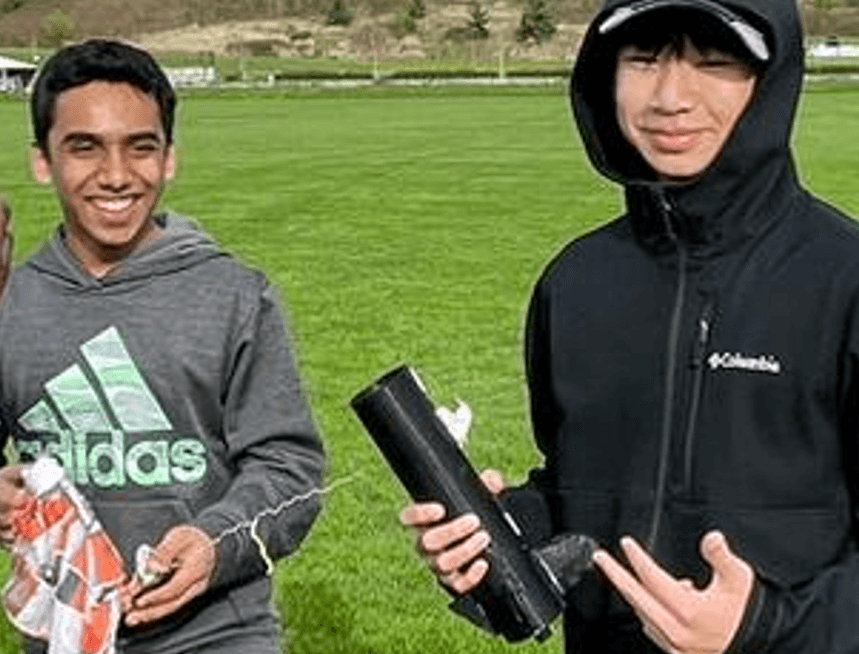
A few days ago, my rocketry team and I headed out to 60 Acres Park in King County, Washington, for our final qualifying launch day for the American Rocketry Challenge (TARC) - the world's largest student rocket contest, with nearly 5,000 students competing nationally each year. The typical Seattle clouds dotted the sky, with occasional glimpses of sun and almost no wind: ideal conditions for launching without any hitches. On each countdown - 5, 4, 3, 2, 1 - we watched our rockets leave the pad trailing smoke with a distinct whooshing sound, held our breath through apogee, and then opened the nose cone to check the onboard altimeter. The reading that stuck with me: 841 feet, in a 44.3-second flight.
I joined my high school's rocketry club at Tesla STEM High School almost by accident - a few middle school friends had signed up, and I wanted to try something new. I didn't expect launching model rockets to become such a complex, competitive hobby. Tesla STEM's club competes every year in TARC, where teams that qualify for the National Finals compete for cash prizes - a bar that, that season, meant landing near 820 feet in altitude with an uncracked egg payload inside a roughly 45-second flight window. That combination of precision and payoff is what hooked me.
TARC doesn't reward the highest or fastest rocket - it rewards the one that lands closest to a narrow target altitude and duration band, carrying a raw egg that survives the entire flight uncracked. Miss the altitude band, miss the timing window by even a couple of seconds, or crack the egg on landing, and the flight scores against you no matter how clean the launch looked. Being fairly new to model rockets, our team's early choices in motors and recovery hardware badly misjudged that balance - we assumed more altitude margin meant a safer flight, which very nearly got us disqualified before we ever reached the qualifying launches.
- Target altitude band close to 820 ft - overshooting scores no better than undershooting.
- Total flight duration, boost to landing, has to fall inside a roughly 45-second window.
- The onboard raw-egg payload must land completely uncracked, or the flight scores against the team regardless of altitude or timing.
- Only the best two of three qualifying launches count toward the final score, so consistency across attempts matters as much as any single flight.
- Motor impulse and parachute size trade directly against each other - too much of either risks a structural failure, an unrecoverable drift, or blowing straight through the duration window.
Scaling down motor selection after an overpowered test flight
For our first test launch we picked an Aerotech F50T-6 motor - 79.6 N of max thrust - paired with an oversized 36 cm parachute, reasoning that more power and a bigger canopy meant a safer margin. The rocket shot to roughly 1,200 feet, well past the ~820 ft target, and the top body tube holding the egg tore free from the rest of the airframe as the oversized chute deployed. It drifted so far downwind we couldn't even retrieve it - an automatic disqualification.
Reason:
TARC scores proximity to a fixed altitude and duration target, not maximum performance, so a motor sized for 'extra safety margin' is actually a liability - it also stresses the airframe joints far beyond what the recovery system was built to survive.
Tradeoff:
Downsizing the motor meant re-simulating the whole rocket's stability and mass budget from scratch, costing us a design iteration we hadn't planned for before the qualifying window opened.
Resizing the parachute for the scoring window, not just a soft landing
The original 36 cm chute was sized to match the oversized motor, and its slow descent both fed the drift that lost us the rocket and pushed total flight time out of range. We resized the canopy specifically against the ~45-second duration target, trading some descent softness for a flight profile that would actually land inside the scoring window.
Reason:
Parachute size in TARC is a scoring parameter, not just a safety feature - it directly sets descent time and drift distance, both of which the competition measures.
Tradeoff:
A smaller canopy comes down faster, which raises landing shock on the payload bay - so the egg protection inside had to be reinforced to compensate.
CAD-modeled nose cone and OpenRocket stability simulation before any rebuild
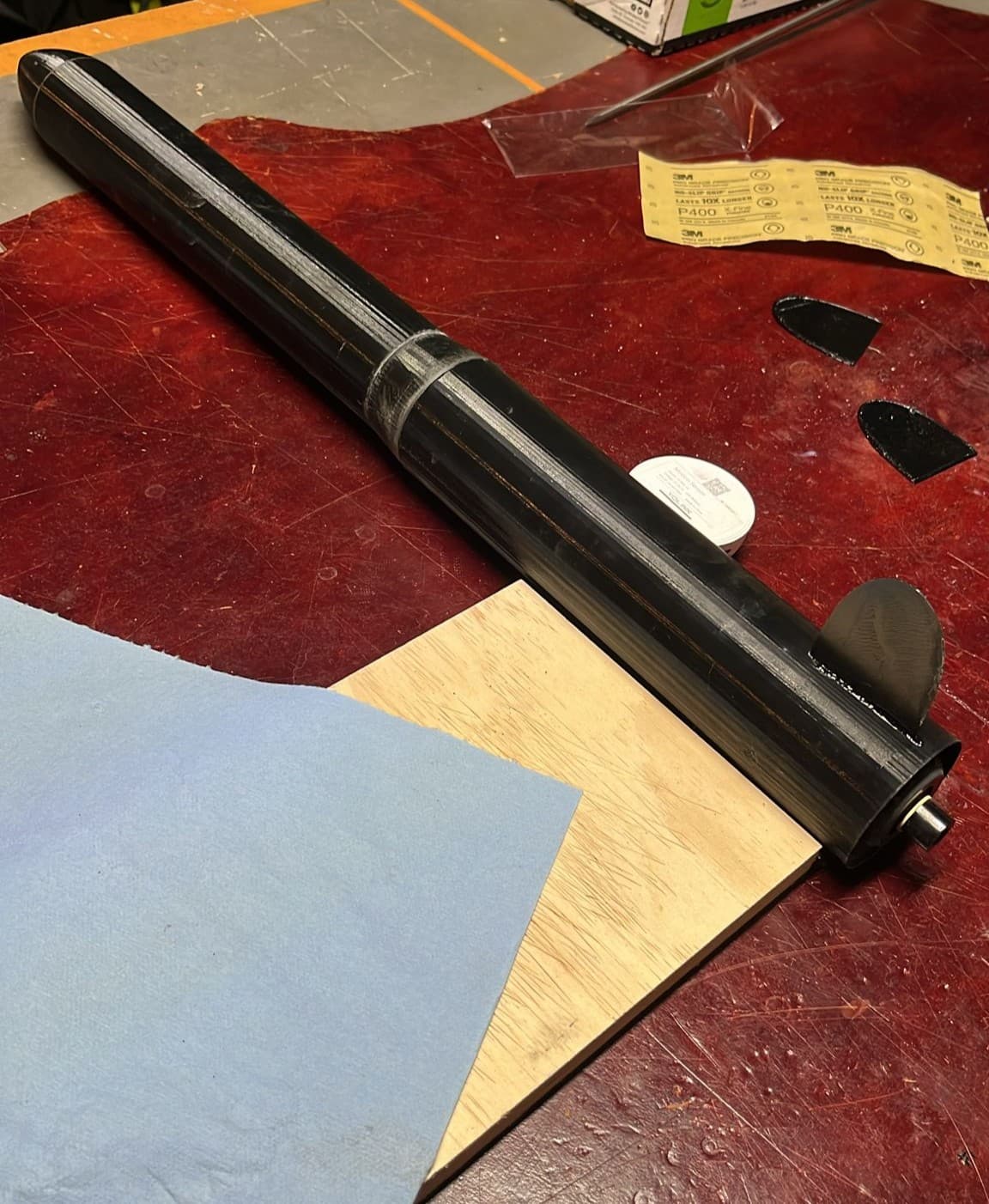
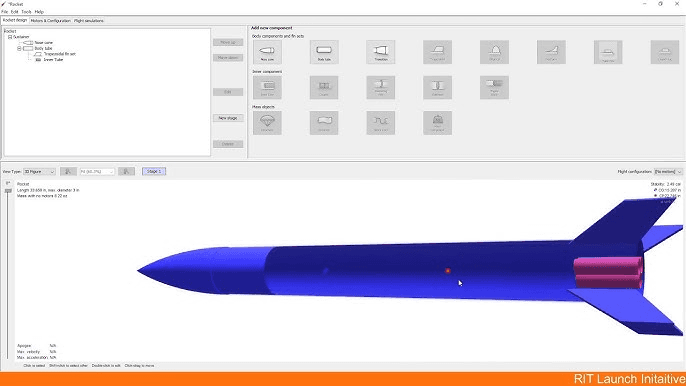
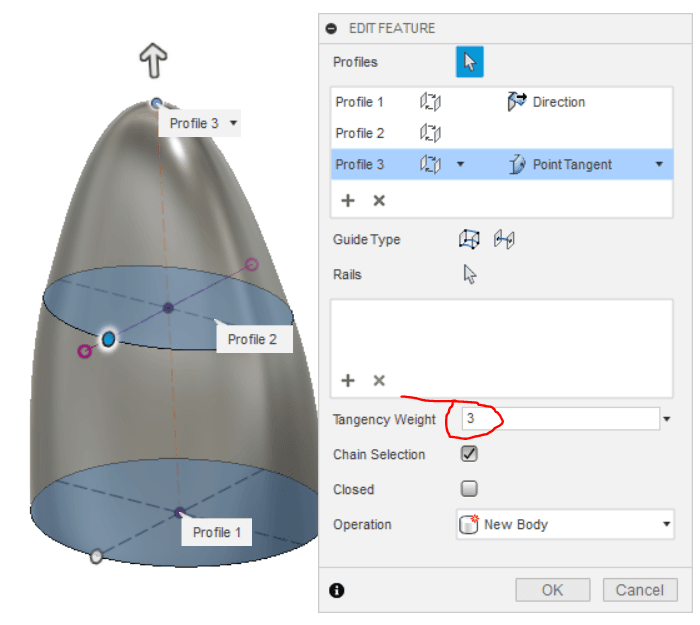
Instead of another trial-and-error test flight, we modeled the new nose cone in SolidWorks as a multi-profile loft - tuning the tangency weight between profile curves to shape a clean ogive that met the body tube without a visible seam - and validated the full airframe's mass distribution and stability margin in OpenRocket before cutting or gluing anything.
Reason:
After losing a rocket to a bad motor/recovery pairing, we couldn't afford to find a second design flaw by flying it - simulating stability margin and drag digitally is free, while another disqualified launch would have cost us the qualifying window entirely.
Tradeoff:
Modeling everything up front added real design time the team hadn't budgeted for initially, but it caught issues a physical test flight would have caught far more expensively.
Adding a dedicated altimeter bay and reinforced egg protection
Every qualifying flight needed a verifiable, logged altitude and duration reading, so we built a dedicated bay for an onboard altimeter, and reworked the payload compartment's padding and shock-cord routing so the egg could survive both the motor's initial thrust and the parachute's opening shock.
Reason:
Judges score off the altimeter's logged data, not an estimate - and a single cracked egg voids an otherwise perfect flight, so payload protection had to be treated as seriously as propulsion or recovery.
Tradeoff:
The extra bay added weight and volume that ate into our altitude margin, so it had to be balanced carefully against the motor choice we'd already locked in.
- First test flight overshot to roughly 1,200 ft, tore apart at the body tube joint under an oversized parachute, and drifted out of reach - an automatic disqualification that forced a full redesign.
- Redesigned rocket completed all three official qualifying launches at 60 Acres Park with the egg intact every time: Launch 1 - 848 ft in 45 s; Launch 2 - 841 ft in 44 s; Launch 3 - 857 ft in 39 s.
- Landed within about 20 ft of the ~820 ft altitude target on our best flights, and dead-on the ~45-second duration window - a scoring band that most teams hitting those marks go on to qualify for nationals.
- Competed within a national field of nearly 5,000 students across the American Rocketry Challenge that season.
- Matching motor impulse to the airframe's actual design margins matters more than maximizing altitude - 'more power' is a liability in a competition scored on precision, not performance.
- Recovery system sizing (parachute diameter) is a scoring parameter in its own right - it sets descent time and drift distance, not just landing softness.
- Simulating stability and drag in OpenRocket and CAD before a rebuild is far cheaper than finding the same flaw by flying it again.
- A single failure point - one oversized chute, one cracked egg - can void an otherwise perfect flight, so payload protection deserves the same rigor as propulsion.